
Common Technical SEO Issues That Drop Your Rankings
Published 11 April 2026
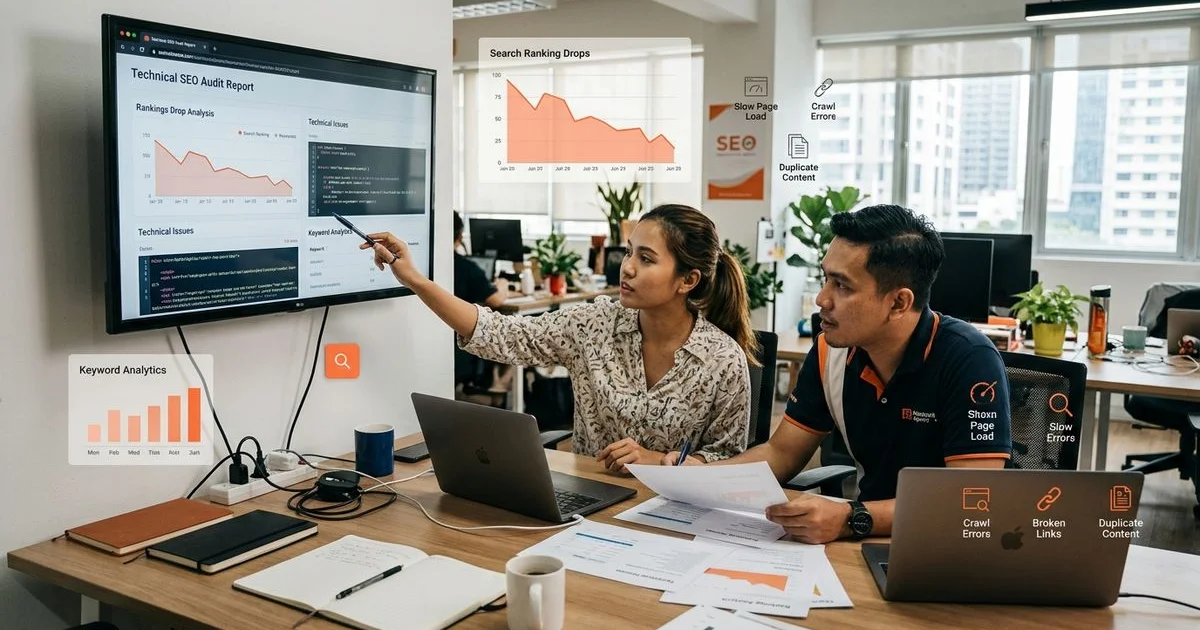
You know how a sudden drop in website traffic feels like a major crisis. Yet, the real damage usually comes from common technical SEO issues that slowly erode your visibility without triggering any alarms.
Our team at Adam SEO relies on comprehensive technical SEO audits to catch these invisible roadblocks early.
The most frequent technical faults are often simple to fix once they become visible. Here is a breakdown of the biggest ranking drops and the practical steps to resolve them.
Indexation errors

We often find that SEO errors related to indexation are the silent culprits behind missing search traffic. A page simply cannot rank if Google refuses to include it in their active database. Causes include accidental noindex tags, blocked pages in your robots.txt file, or pages search engines simply have not been told to crawl.
Our experts highly recommend checking the specific “Crawled, currently not indexed” status in Google Search Console. This notification means Google found your URL but decided against putting it in the search results. E-commerce stores with massive product filters often generate thousands of low-value pages that trigger this exact technical SEO problem.
We suggest auditing your key pages regularly. A page that should rank but is missing is highly fixable. Watch out for these frequent indexation traps:
- Accidental noindex tags left over from development.
- Faceted navigation creating thousands of thin category pages.
- Vital pages blocked entirely by the robots.txt file.
Broken redirects and duplicate content
Our audits frequently reveal websites losing valuable ranking power to tangled redirect chains. Broken redirects and endless loops waste your crawl budget and frustrate both search engines and visitors. Googlebot officially stops following a redirect path after five consecutive hops.
We view this technical limitation as a major risk, because any target page beyond that fifth step becomes completely invisible. Duplicate content, which means the same or near-identical content on multiple URLs, splits ranking signals so no version ranks as well as it should. These two issues together cause a surprising amount of lost visibility.
Our strategy is to map redirects cleanly and use canonical tags. You must point search engines to the right version of any duplicated page.
| Redirect Chain Length | SEO Impact | Recommended Action |
|---|---|---|
| 1 Hop | Perfect resolution | Maintain current setup |
| 2 Hops | Minor crawl delay | Acceptable, but monitor |
| 5+ Hops | Complete bot drop-off | Fix immediately |
Slow pages and mobile issues
We know that slow pages hurt both rankings and conversions. Mobile performance is absolutely critical right now. A recent April 2026 report from the Department of Statistics Malaysia highlights that mobile phone access among local households is virtually universal at 99.5 percent.
Our regional clients see the sharpest impact on mobile devices because most visitors and most searches happen there. A site that is hard to use on a phone with tiny tap targets, overflowing content, or slow loads will lose customers quickly. Page speed ties directly into the latest metrics, which we cover in Core Web Vitals explained.
We constantly monitor Interaction to Next Paint (INP), a key metric that replaced First Input Delay in March 2024. Google requires an INP score under 200 milliseconds for a site to feel snappy and responsive. Mobile-friendliness is non-negotiable for Malaysian audiences.
You should evaluate these specific performance benchmarks:
- LCP (Largest Contentful Paint): Keep loading speeds under 2.5 seconds.
- INP (Interaction to Next Paint): Maintain responsiveness under 200 milliseconds.
- CLS (Cumulative Layout Shift): Ensure visual stability scores stay below 0.1.
How to diagnose common technical SEO issues

Our technical teams rely on regular crawl audits to catch these errors early. The reliable way to find these problems is using a crawler tool alongside Google Search Console. Tools like Screaming Frog allow you to scan up to 500 URLs for free, making it highly accessible for regional SMEs.
We use the crawl to surface broken links, bad redirects, duplicate content, and indexation problems. Search Console then shows how Google actually sees your site in real time. Run an audit periodically, not just once.
Our experience shows that sites accumulate massive technical debt over time. If the topic is new, start with what technical SEO is.
Building a maintenance routine
We recommend setting up a quarterly schedule to review your site health. Fixing common technical SEO issues proactively will protect your search visibility and keep your business growing.
Start your first diagnostic scan today to see exactly where your site stands.
Related service: Technical SEO Services