SEO vs Google Ads — Which Is Better for ROI?
Published 17 February 2026
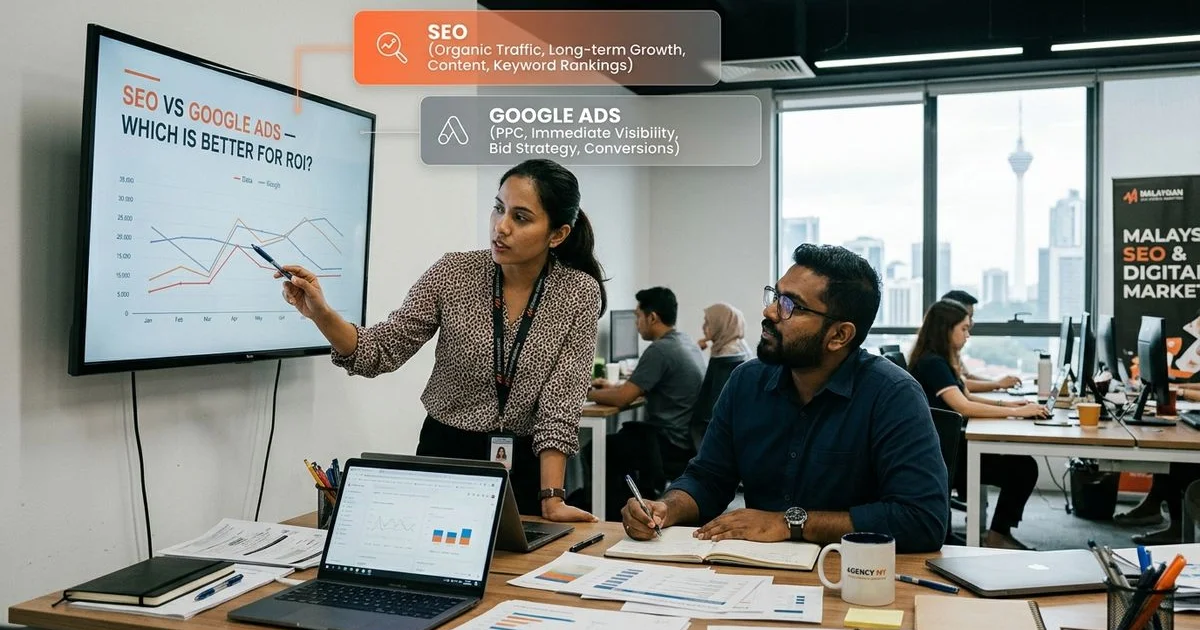
We often field a very specific question from business owners across Malaysia. “Should I invest in SEO or just run Google Ads?” is a debate that shapes many marketing budgets.
Our team views these platforms as solutions to entirely different problems. Treating them as an either-or choice usually hurts your profit margins.
We evaluate the SEO vs PPC ROI using the framing from ROI-focused SEO, which judges each channel by the revenue it produces against its cost instead of just counting clicks.
This data-driven perspective reveals exactly how each method affects your bottom line.
Our following sections will outline a practical framework for allocating your search marketing budget.
Cost-per-lead over time

Google Ads charges you for every click, every day, forever. We see standard search campaigns in Malaysia typically costing between RM 1.20 and RM 5.50 per click in 2026.
The cost-per-lead remains fairly stable initially but rises as market competition increases. Our data shows that the traffic stops the exact moment you turn off your ad spend.
Comparing organic vs paid search reveals completely opposite financial dynamics. We note that the upfront investment is higher relative to early returns.
A 2025 study from CI Web Group reveals that the cost per paying customer for organic leads is roughly $126, compared to $552 for paid ads over a sustained period.
Our clients experience a dramatic drop in cost-per-lead as rankings build, because the traffic keeps coming without paying per click. Several factors drive up the average cost of paid clicks over time.
Our agency monitors these common triggers:
- Increased bidding wars among local competitors
- Higher keyword minimums enforced by ad platforms
- Seasonal demand spikes during major shopping events
- Automated bidding algorithms pushing up auction prices
These rising costs make long-term reliance on paid traffic very expensive. We recommend planning ahead to avoid getting trapped in a cycle of endless ad spending.
SEO as an owned, compounding asset
Paid ads are essentially rented attention. Our founder, Adam Yong, established Adam SEO in 2011 on the core premise that true business growth requires building an owned asset.
Every ranking page you build keeps working and compounds as your site authority grows. We use a simple comparison to illustrate the difference between renting and owning search visibility.
| Feature | Google Ads (Rented) | SEO (Owned) |
|---|---|---|
| Traffic Duration | Stops immediately when budget runs out | Continues long after initial work |
| Cost Per Lead | Remains flat or increases over time | Decreases significantly as authority builds |
| Asset Value | Zero residual value | Highly valuable digital real estate |
Existing organic rankings still earn revenue even if you pause adding new content. Our analysis of 2026 data from SeoProfy confirms that organic search campaigns often yield a median return of 748 percent.
That compounding effect is the real financial argument for choosing an organic approach. We discuss why these results require patience in our detailed guide on how long SEO takes.
Breaking even on an organic campaign typically takes six to twelve months. Our team focuses on pushing past that break-even point to reach the phase where profit margins expand rapidly.
When each channel makes sense
When deciding between SEO or PPC, Google Ads shines brightly when a business needs traffic right now. Our clients use paid search effectively for product launches, seasonal promotions, or testing whether a new market converts.
The paid platform is fast and highly controllable. Our analysts review local metrics to set realistic timelines.
A 2026 report from ZenWeb indicates that Malaysian e-commerce stores typically hit a solid break-even point with Google Ads in about two to four months.
We find that organic optimization shines when a company wants durable, lower-cost visibility that survives without constant spending. This foundational strategy allows paid ads to act as a temporary accelerant.
Our team generally recommends splitting your focus based on these specific triggers:
- Use paid ads when launching a brand-new website with zero domain authority.
- Use paid ads when running a limited-time holiday sale requiring instant clicks.
- Prioritise organic search when targeting high-volume keywords that cost too much per click.
- Prioritise organic search when building a long-term strategy to capture users early in their research phase.
Most established businesses require a thoughtful mix of both approaches to stay competitive. Our next section explains how to combine them effectively.
The case for a hybrid strategy
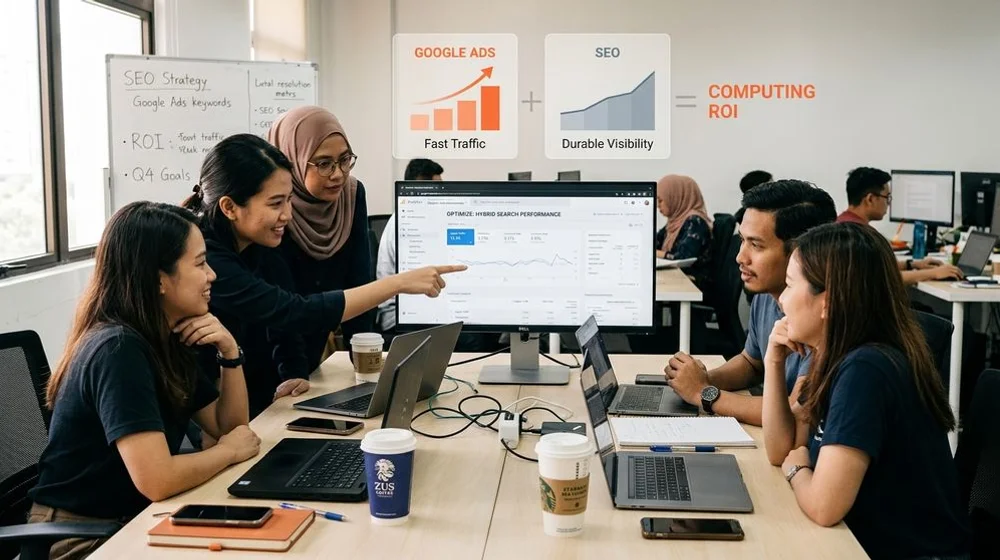
The strongest market position always involves running both channels simultaneously. Our hybrid method uses ads to cover you while the organic asset builds.
The organic rankings eventually carry the lower-cost load as they mature. We use paid keyword data to learn exactly which search terms actually generate sales.
This real-time data sharply improves your organic targeting efforts. Our marketing managers can identify high-converting phrases from ad campaigns and apply them directly to website content.
Recent 2026 figures from ZenWeb show that most Malaysian SMEs successfully run a combined total budget of RM 4,000 to RM 8,000 per month on search marketing, capturing both immediate leads and future growth.
We use these benchmarks to help clients scale their operations safely. A resilient business never depends entirely on a single traffic source.
Our combined approach pairs the speed of ads with the durability of organic search to deliver both quick wins and a compounding asset. The smartest move you can make today is auditing your current search marketing spend to identify missed revenue opportunities.
Our experts are ready to help you implement this highly profitable dual-channel strategy.