
What Are AEO and GEO (AI Search Optimization)?
Published 28 March 2026
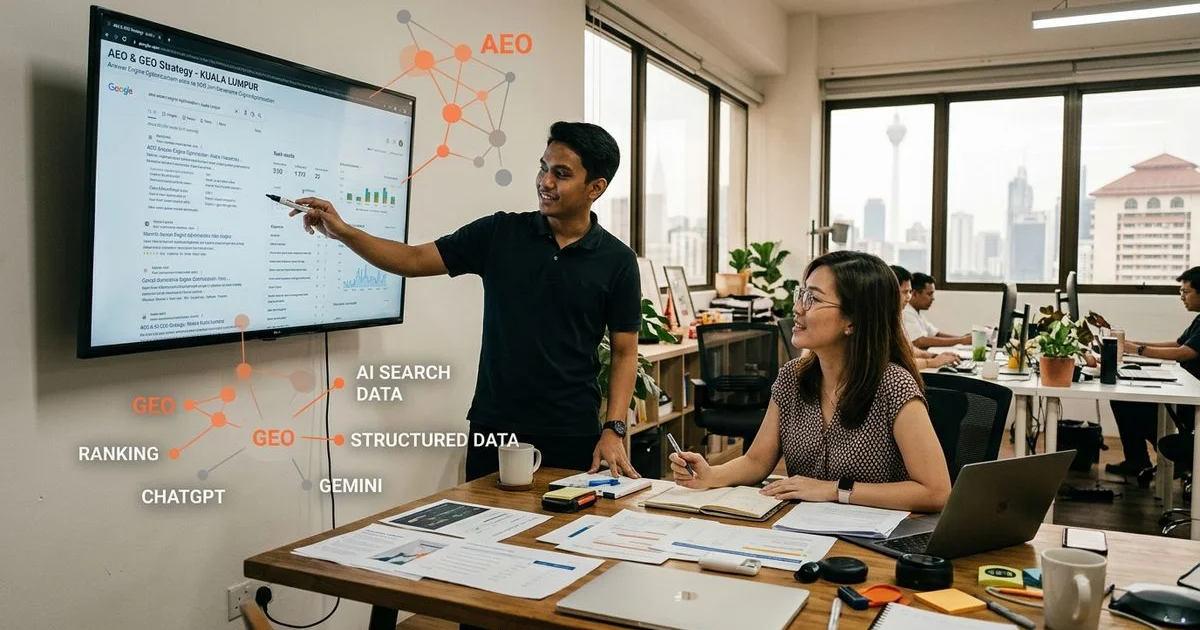
We have all seen the sudden drop in traditional organic clicks across our marketing dashboards this year. That metric is exactly why smart business owners are asking what is aeo and geo.
People are actively getting their questions answered directly by artificial intelligence.
Since Adam Yong founded Adam SEO in 2011, our premise has always been that search engine rankings alone are meaningless without tangible business results. Being featured in these direct answers requires a new layer of strategy. You need to ensure tools like ChatGPT and Google Gemini actually mention your specific company and drive real conversions.
This shift forms the foundation of our AI search optimization service, and it builds directly on solid SEO principles rather than replacing them. Let us look at the data, what it actually tells us, and how you can adapt your visibility strategy.
What is AEO and GEO: Definitions

AEO stands for Answer Engine Optimization, while GEO stands for Generative Engine Optimization. Both concepts focus on making your business the trusted source an artificial intelligence uses to generate a direct response. AEO targets voice assistants and simple answer engines that pull a single factual response.
GEO specifically targets the longer, conversational summaries created by tools like ChatGPT or Google AI Overviews.
We track these distinct systems closely because they process information differently. The term generative engine optimization was formalised in a 2023 study by researchers at Princeton University, describing the practice of structuring content specifically for AI synthesis.
Gartner predicts that 40% of B2B queries will be satisfied entirely inside an answer engine by 2026, forcing a major shift in visibility strategies.
This means your marketing approach must adapt to serve both simple fact-retrieval systems and advanced language models simultaneously.
Key Differences Between AEO and GEO
Our team uses a clear framework to distinguish these two optimisation layers. The required technical setups differ slightly depending on the exact engine you want to target.
| Feature | Answer Engine Optimisation (AEO) | Generative Engine Optimisation (GEO) |
|---|---|---|
| Target Systems | Voice search (Siri, Alexa) and simple knowledge graphs | Large Language Models (ChatGPT, Gemini, Google AI Overviews) |
| Response Type | Single, direct factual answer | Synthesised summary from multiple competing sources |
| Primary Tactic | FAQ schema, local business profiles, exact pricing facts | In-depth context, expert quotes, unique local statistics |
How AI engines build answers

Artificial intelligence engines pull from sources they trust, weigh the facts, and assemble a coherent answer. Some models retrieve current information from the web in real time, while others rely entirely on what they learned during their initial training.
They universally favour content that is clear, deeply structured, and backed by undeniable authority. Our engineers observe that these systems use a process called “Chain of Thought” reasoning to break down complex user intents.
They actively look for “Citation Authority,” meaning they prefer statements verified by established, trustworthy domains.
Research from Princeton University confirms that adding unique statistics and direct expert quotes improves content visibility in AI answers by 30% to 40%.
You must give the algorithm a factual reason to choose your paragraph over a competitor’s generic text. We go much deeper on earning those specific citations in how to get cited by ChatGPT and Gemini.
Structuring for Machine Readability
You cannot just write a block of text and hope an AI understands the context. The engine needs explicit signals to confidently cite your business details.
- Format with clarity: Use bullet points and short sentences to define core concepts.
- Embed hard data: Support every major claim with recent, verifiable numbers.
- Highlight author expertise: Connect your content to verified author profiles showing real industry experience.
- Use descriptive headings: Frame your subheadings as direct questions that buyers actively ask.
Why it matters now
More people are securing answers straight from artificial intelligence without clicking a single traditional search link. If your Malaysian SME or e-commerce store is missing from that generated answer, you are entirely invisible at the exact moment a buyer is deciding.
This transition is happening incredibly fast. Our agency tracks regional search behaviours daily, and the local data highlights a severe risk for slow adapters:
- Google AI Overviews now appear on roughly 40% to 60% of all commercial search queries in Malaysia.
- Local shoppers are reading AI summaries about the best cafes or software tools instead of visiting individual business websites.
- ChatGPT usage in Malaysia spiked by an estimated 330% over the last year among both consumers and business professionals.
Many local job seekers and managers now use these platforms for daily research, drafting, and problem-solving. This rapid adoption is exactly why we treat AI visibility as part of your core baseline strategy rather than a distant future concern.
The Conversion Advantage of Cited Answers
Being cited by an AI engine brings a massive advantage in targeted traffic. The visitors generated from an AI citation behave differently than standard organic clicks.
Recent data from Microsoft Copilot shows that click-through rates on cited AI answers are up to six times higher than classic organic links. A user who clicks a citation has already read the context and validated your authority. They arrive on your site highly motivated and ready to take action.
Relationship to traditional SEO
AEO and GEO absolutely do not replace standard search engine optimisation, because they actually build directly on top of it. The authority, site architecture, and trust signals that help you rank on traditional search engines also help generative AI models choose you as a source.
Strong technical SEO provides the stable foundation. Generative engine optimization acts as the specialised layer that extends your reach into AI-generated answers.
Our research indicates that the connection between classic rankings and AI visibility is incredibly strong.
Recent industry studies show that 73% to 74% of the information displayed in Google AI Overviews is pulled directly from websites already ranking in the top 10 traditional search results.
If you hold the number one position, you have a 53% chance of being included in the AI summary. The Department of Statistics Malaysia noted that local business web presence reached 70.9% back in 2022.
Having a basic website was enough for the old digital economy, but it falls short today. You need structured data like FAQPage schema to feed specific facts to the engines.
For a fuller, detailed comparison of these methodologies, see AEO and GEO vs traditional SEO.
Core Pillars Shared by Both Strategies
You do not need to abandon your current marketing efforts to prepare for AI search. The most effective campaigns unify both approaches using a few shared principles.
- Fast page speeds: AI crawlers and human users both abandon slow-loading pages.
- Mobile-first design: Malaysia has a massive smartphone penetration rate, making mobile usability critical for both Google rankings and AI data retrieval.
- High-quality backlinks: Mentions from authoritative regional news sites or industry blogs validate your credibility to both traditional algorithms and language models.
- Clear site hierarchy: Logical folders and category pages help bots map relationships between your products and services.
Conclusion: Next Steps for AI Search Optimization
Understanding the ai search optimization meaning is just the first step in protecting your digital presence. The data is completely clear that traditional link clicking is declining while AI-driven discovery is growing rapidly across Malaysia.
Now that you know exactly what is aeo and geo, it is time to audit your current content.
We recommend checking your most valuable pages to see if they include clear facts, expert quotes, and structured data. Start updating those pages today to secure your place in the next generation of search.
Related service: AEO & GEO (AI Search Optimization)