
How to Rank in the Google Map Pack (Local 3-Pack)
Published 10 March 2026
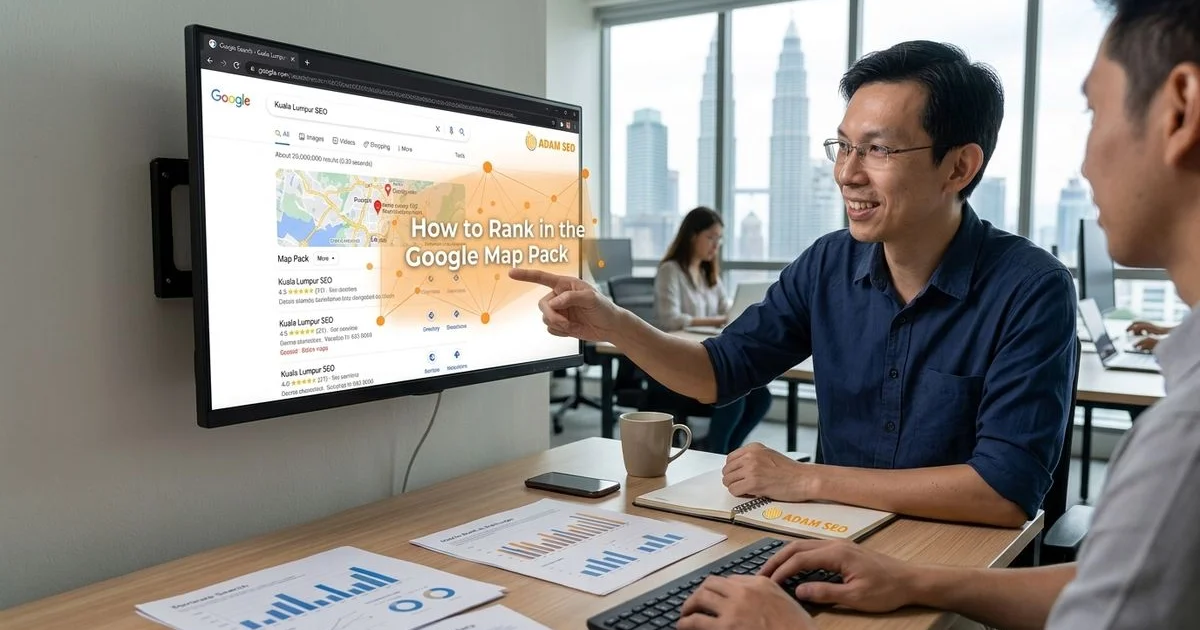
We often see competitors with inferior products dominating the top of local search results simply because they understand exactly how to rank in the Google Map Pack. Those three coveted map spots capture the vast majority of clicks, calls, and direction requests before a customer even scrolls down.
Earning one of those positions is a central goal of any local SEO campaign.
Our experience shows that the rules for regional visibility have shifted significantly in 2026. Data indicates that proximity and profile completeness now carry more weight than ever before.
This guide breaks down the most important signals and shares practical ways your Malaysian business can secure that placement.
The signals behind 3-pack rankings
Our data confirms that ranking in the Map Pack requires a precise combination of proximity, relevance, and prominence. Your Google Business Profile must be fully optimised to send these three specific signals to the algorithm.

The 2026 Whitespark Local Search Ranking Factors Survey shows that Google Business Profile signals account for roughly 32% of your ranking influence. We rely on these hard statistics to guide our Google local pack SEO strategies. This makes the profile itself the single most critical asset for local visibility.
Current industry data confirms that only 44% of profiles are fully completed. Our audits reveal that many regional businesses leave key fields completely blank. A comprehensive profile actually delivers up to seven times more clicks than a basic listing.
The algorithm evaluates three specific areas to decide who gets shown:
- Proximity: This is the physical distance between your store and the person searching.
- Relevance: The search engine checks if your primary category and business name match the user intent.
- Prominence: This factor measures your entity authority through reviews and citations.
We distribute campaign resources based on these confirmed ranking weights. This breakdown highlights exactly where you should direct your energy. Table statistics provide a clear path forward for optimisation.
| Ranking Signal | 2026 Influence Weight | Primary Action Required |
|---|---|---|
| Google Business Profile | 32% | Complete all attributes and categories |
| Review Authority | 20% | Generate steady 4.5-star feedback |
| On-Page Website Signals | 15% | Optimise local landing pages |
Review velocity and reputation
We always emphasise that consistent, positive reviews are the strongest trust signal you can send to both search engines and potential customers. You need a steady stream of recent feedback to maintain a map pack ranking.
The mathematical impact of review ratings
According to recent local search statistics, 88% of users trust online reviews when making purchasing decisions. Our campaign data indicates that businesses with 50 or more reviews are 266% more likely to appear in the local 3 pack.
A perfect 5.0 rating often looks suspicious to modern Malaysian consumers. The ideal sweet spot for conversions is actually a 4.5-star average.
We advise business owners to encourage customers to mention specific products or services in their feedback. Review text keywords act as a highly powerful supporting ranking signal. For example, a review stating “best iced latte in Penang” carries more SEO weight than a simple “great cafe.”
Keyword relevance and review management
Our standard practice is to reply to all criticism professionally to build trust with future buyers. Responding to every single review proves to the algorithm that the location is actively managed. Building a reliable pipeline for customer feedback requires a proactive operational approach.
We recommend implementing automated request systems immediately after a purchase. Waiting and hoping people leave a rating organically is not a viable strategy. These small operational changes create a massive difference in your monthly numbers:
- Strike quickly: Send the request while the positive experience is fresh.
- Remove friction: Provide a direct link straight to your Google review form.
- Train your staff: Encourage frontline employees to ask satisfied customers for a quick rating.
Citations and NAP consistency
We view citations as digital references for your business across the web, confirming your exact location and details. Maintaining absolute consistency with your Name, Address, and Phone number (NAP) across all directories is non-negotiable.

Mentions on reputable platforms validate your physical existence to the search algorithms. Our team starts by auditing existing profiles on major Malaysian directories like Cylex Malaysia, Hotfrog Malaysia, and Opendi. The latest data indicates that citations are making a strong comeback for visibility in AI-driven search results.
Mismatched details confuse search engines and severely dilute your ranking potential. We stress the importance of keeping every single platform perfectly synced to avoid indexing issues. Even a slight variation, like using “Jalan” on one site and “Jln” on another, causes major problems.
| Citation Type | Malaysian Examples | Impact on Local SEO |
|---|---|---|
| Primary Aggregators | Google, Apple Maps | Critical for baseline visibility |
| Local Directories | Cylex Malaysia, Hotfrog | Builds regional entity authority |
| Industry Portals | TripAdvisor, PropertyGuru | Drives targeted niche traffic |
This exact synchronisation process builds directly on the work discussed in our guide to optimising your Google Business Profile. Our data confirms that consistent information across the internet tells the algorithm your business is active and reliable.
Different citation tiers work together to establish a concrete digital footprint. Missing out on local directories leaves a massive gap in your regional relevance.
Proximity factors and tracking
We know that proximity to the searcher is the one ranking factor you cannot manually change or optimise. Your strategy must focus on strengthening every other signal to expand your visible radius as far as possible.
The algorithm prioritises users who are physically closest to your location at the exact moment of their search. We often explain to clients that a single physical store will never rank first for every user across Kuala Lumpur. To combat this geographical limit, you must build overwhelming relevance and prominence.
Grid-based rank tracking tools like Local Falcon or BrightLocal offer the best method for measuring success. Our preferred workflow involves plotting your search visibility on a map to see exactly where your rankings drop off. For instance, you might rank in position one within a 1km radius, but drop to position six at a 3km distance.
Tracking your geographic search footprint
This specific grid data identifies which surrounding neighbourhoods need targeted local content or location-specific backlinks. We track behavioral signals, like mobile clicks and direction requests, to show how well that expanded visibility converts into actual foot traffic. If the mechanics of regional search are entirely new to you, our primer on what local SEO is provides a great starting point.
A solid campaign will always monitor three specific performance metrics:
- Grid Visibility: How your ranking changes based on physical distance.
- Profile Interactions: The number of calls and direction requests generated.
- Discovery Searches: How many users find you by searching for a category rather than your exact name.
Conclusion
We know that figuring out how to rank in the Google Map Pack takes consistent effort and accurate data. The strategies outlined above give you a clear roadmap to bypass local competitors and capture high-intent traffic.
Claiming and fully completing your Google Business Profile is the best place to start today. Our team is always available to help audit your current visibility and build a strategy that drives real foot traffic to your door.
Related service: Local SEO Services