
How to Redesign Your Website Without Losing SEO Rankings
Published 15 April 2026
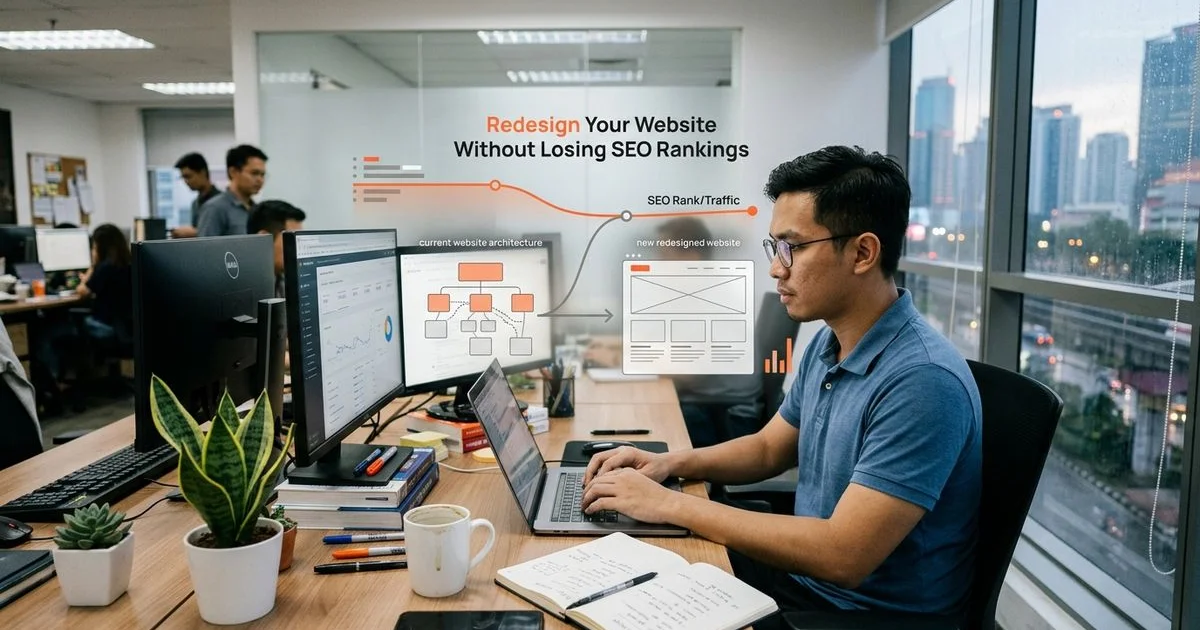
Our agency, Adam SEO, was founded in 2011 by SEO veteran Adam Yong on a simple premise: search rankings are meaningless without tangible business results. Recent 2025 industry data from sitecentre shows that nearly 68% of businesses experience a traffic drop following a major website update.
We know the excitement of launching a fresh, modern site, only to watch organic traffic plummet the next day. Learning how to redesign website without losing seo is absolutely critical for long-term growth.
Our team considers protecting these rankings to be a core part of our SEO web design work. A prettier site that ranks worse is simply a backward step for any Malaysian business.
We will now walk through the exact four-step protocol needed to keep your search visibility intact.
URL preservation to redesign website without losing SEO
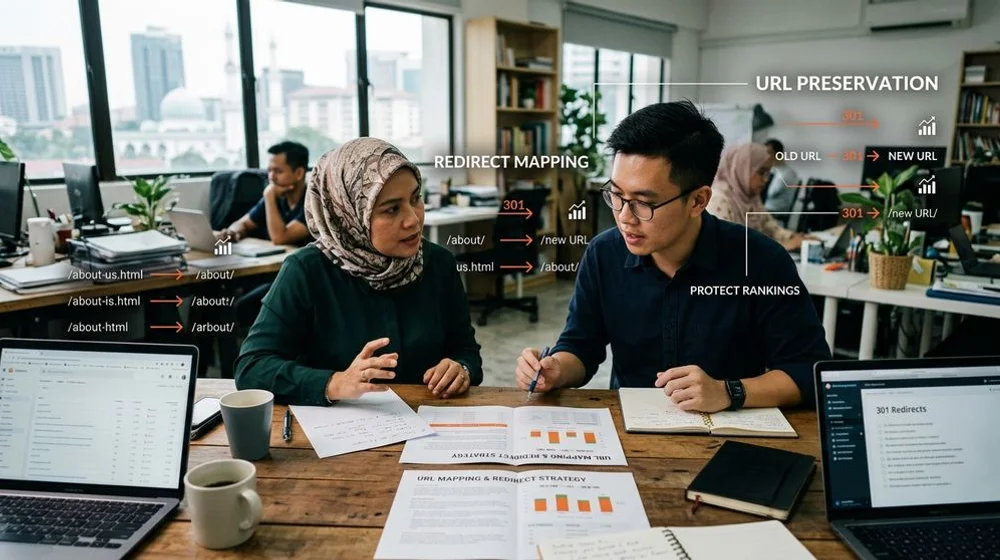
Search engines attach your historical ranking signals directly to your specific web addresses. Our first rule of any project is to keep your existing URL structure exactly the same wherever possible.
Changing a high-performing URL without a strategic reason is equivalent to throwing away years of hard work. We use tools like the Screaming Frog SEO Spider to crawl a client site before development even begins.
This software extracts a complete list of your current pages, ensuring no address gets accidentally abandoned. Our team always audits these specific URL components to maintain structural consistency:
- Protocol choices: Forcing all traffic to the secure HTTPS version instead of creating HTTP duplicates.
- Trailing slashes: Preventing the accidental addition of a slash at the end of a URL, which Google treats as a completely separate page.
- Subdomain usage: Keeping the primary content on the main domain rather than splitting it across new subdomains.
- Case sensitivity: Ensuring all new permalinks strictly use lowercase letters to prevent broken links.
These precise URL preservation tactics prevent search engines from dropping your most valuable pages. We always finalize the new address structure deliberately before the launch day arrives.
Silent, unmapped URL changes are the fastest way to destroy your organic visibility.
Redirect mapping
We consider changing URLs without proper 301 redirects to be the single biggest risk during any site migration. A 301 redirect acts as a permanent forwarding address that tells search engines exactly where a page has moved.
Our developers rely on these commands because they successfully pass up to 99% of the original ranking value to the new destination. Failing to implement them causes visitors to hit dead ends, and rankings will drop rapidly as a result.
We build a complete redirect map spreadsheet long before the new server goes live. This document systematically pairs every single old URL with its most relevant new counterpart.
Our SEO specialists use specific status codes to communicate exactly what happened to the old content.
| Redirect Status Code | Technical Meaning | SEO Impact & Best Use Case |
|---|---|---|
| 301 Permanent | The page has permanently moved to a new URL. | Passes up to 99% of ranking value. Best for permanent redesigns. |
| 302 Temporary | The page is temporarily located elsewhere. | Does not pass full link equity. Use only for short-term maintenance. |
| 404 Not Found | The page has been permanently deleted. | Drops the page from the index. Use only when content has no replacement. |
This clear classification prevents search engines from getting confused during the crawl. We actively avoid creating redirect chains, where one page bounces to multiple addresses before reaching the final destination.
Multiple hops slow down page speed and severely dilute the link equity being passed along. Our experts strongly advise against the lazy tactic of redirecting all removed pages straight to your homepage.
Google treats mass homepage redirects as soft 404 errors, effectively erasing all the historical SEO value associated with those specific pages.
Staging audits and content parity

We mandate a full technical audit of the new site within an isolated staging environment before any public launch. Content parity matters immensely, because dropping the exact text or headings that originally earned your rankings will drag those rankings down with it.
Our analysts carefully verify that all meta titles, descriptions, and core body copy carry over to the new layout intact. Local Malaysian web hosts like Exabytes offer “One-Click Staging” features for WordPress, making it incredibly easy to duplicate your live setup.
We use these private test servers to safely run our pre-launch checklist without risking your active customer experience.
Staging Environment Checklist
- Indexation prevention: Applying strict “noindex” tags and password protection so Google cannot crawl the unfinished staging pages.
- Schema markup parity: Verifying that critical structured data, like Local Business or Article schema, transfers over to maintain rich search snippets.
- Internal link architecture: Checking that all internal links point to the new destination URLs rather than looping back to the old live domain.
- Image optimization: Confirming that all alt text descriptions remain attached to your product and editorial images.
A rigorous staging phase guarantees that your technical foundation is rock solid before you flip the switch. We always confirm these exact elements are functioning perfectly before giving the final green light to go live.
Post-launch checks
Going live with the new design is only the beginning of the transition process. We spring into action the moment the new site launches to secure your search visibility.
Your immediate priority is to verify that all 301 redirects are firing correctly across every browser.
The 30-Day Rescue Window
Our team submits the updated XML sitemap directly to Google Search Console within the first 72 hours to encourage faster reindexing. Monitoring this platform closely reveals critical crawl errors and indexation issues before they inflict lasting damage.
We expect to see minor ranking fluctuations during the first two to four weeks as Google re-evaluates the fresh architecture. Any sudden organic traffic drop exceeding 15% warrants an immediate technical investigation.
Our specialists constantly check the Indexing reports for spikes in 404 errors during this sensitive period. Catching these specific structural problems early ensures that most redesign dips remain incredibly small and temporary.
We also closely monitor your Core Web Vitals to see how the fresh layout impacts loading times. Page speed is a massive part of this overall performance picture.
Our internal data proves that a faster updated site can lift both rankings and total sales, which we explain fully in website speed, SEO, and conversions.
Conclusion
A proactive strategy is the only way to effectively redesign website without losing seo progress. We recommend building your redirect maps and securing a staging environment well before your launch date approaches.
Protecting your digital equity requires focus, testing, and continuous monitoring throughout the entire development cycle.
We invite you to reach out to our team today to schedule a technical audit for your upcoming project.
Related service: SEO Web Design