
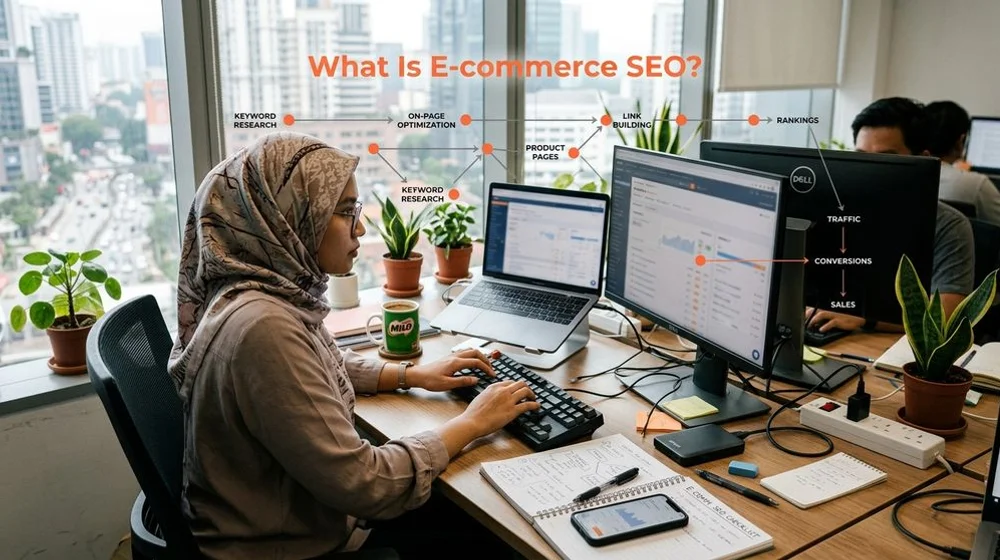
What Is E-commerce SEO?
Published 17 March 2026

We often see businesses pour massive budgets into social media ads, only to watch those clicks bounce right off their product pages. Getting traffic is one thing, but capturing buyers with credit cards in hand is an entirely different challenge.
Our e-commerce SEO service focuses exactly on that transition from casual browsing to confirmed sales.
The 2026 data shows that Malaysian conversion rates sit between 1% and 3%, which leaves a massive margin for improvement.
We founded Adam SEO in 2011 under SEO veteran Adam Yong on the premise that search engine rankings alone are meaningless without tangible business results. Let’s break down the mechanics of online store seo and explore practical ways to turn organic searches into steady revenue.
What e-commerce SEO is
You might be wondering, exactly what is ecommerce seo? E-commerce SEO is the specific practice of optimising an online store to rank for transactional search queries. This strategy ensures your product and category pages appear exactly when buyers are actively looking to make a purchase.
Understanding the true ecommerce seo meaning requires looking beyond basic traffic metrics.
We focus heavily on these buyer-ready terms because they map directly to product revenue. The goal is not just to gather random visitors, but to attract specific users who convert at a high rate.
Our team traces ranking improvements directly to individual sales, making this one of the most measurable marketing channels available.
According to a 2026 report by Reboot Online, the average e-commerce brand ranks for over 1,700 organic keywords, driving traffic that would cost thousands in paid ads.
We use tools like Google Search Console to monitor these exact search terms for Malaysian SMEs. Every incremental position gained on a high-intent keyword can dramatically shift your bottom line.
Our approach to measuring this impact involves tracking three core metrics:
- Organic Conversion Rate: The percentage of search visitors who complete a purchase.
- Average Order Value (AOV): The typical spend of a customer arriving from Google.
- Keyword Revenue Attribution: The specific sales generated by ranking for a particular product name.
Product pages vs category pages
Category pages target broad transactional terms like “men’s running shoes,” while effective product seo requires targeting specific, long-tail queries for a particular model and size. Both page types require distinct strategies, which you can read about in our guide to product and category page optimisation.
We frequently see store owners neglect their category pages, treating them merely as bare product grids. This oversight is a massive missed opportunity for driving revenue. A 2026 Magebit study shows that 70% of online sales actually start on category pages, as shoppers often prefer browsing a curated list before committing to a specific item.
We build category pages to function as comprehensive landing hubs. A well-structured hub includes subcategory links, helpful buying guides, and clear filtering options. Our optimisation process ensures these high-level pages capture top-of-funnel commercial intent.
A simple comparison helps clarify where to direct your focus:
| Feature | Category Pages | Product Pages |
|---|---|---|
| Target Keywords | Broad, high-volume (e.g., “leather boots”) | Specific, long-tail (e.g., “Timberland 6-inch premium boots”) |
| Search Intent | Browsing and comparing options | Ready to purchase a specific item |
| Traffic Volume | Generally higher | Generally lower, but highly qualified |
Transactional search intent

Transactional search intent occurs when a user types a query into Google with the explicit goal of buying a product. These searches are the lifeblood of online store SEO because the searcher has already moved past the research phase.
A 2026 report by Yotpo confirms that targeted, high-intent traffic is the primary driver behind stores achieving a healthy 3% conversion rate.
We prioritise these keywords because they deliver the highest return on investment for our clients. A user searching for “buy wireless earbuds Kuala Lumpur” is actively holding their credit card.
Our strategy involves mapping these specific phrases to the exact pages where the transaction happens. Winning these competitive terms takes solid technical health, fast loading speeds, and strong topical authority.
We consistently optimise product descriptions to match the exact phrasing a buyer uses. Many competitors fail because they rely on generic, manufacturer-provided text instead of writing for the user’s intent.
The most common transactional modifiers used in Malaysia include:
- “Buy” or “Order”: The most direct indicators of a pending sale.
- “Price” or “Harga”: Shows the user is comparing final costs.
- “Near me” or “Kuala Lumpur”: Indicates strong local purchasing intent for brick-and-mortar stores.
- “Discount” or “Promo”: Highlights a buyer looking for a final push to checkout.
How it differs from content SEO
Content SEO focuses on informational searches through blog posts and guides, whereas e-commerce SEO directly targets transactional searches using product and category pages. The platform you build your shop on dictates much of this technical work, which is why a Shopify SEO checklist is essential if you use that system.
We treat online store optimisation as a highly technical discipline. A standard blog rarely deals with faceted navigation, but an online shop can generate thousands of duplicate URLs just from users filtering by size or colour.
Managing Technical Challenges
Our technical audits frequently reveal that these uncontrolled filters are the number one cause of wasted crawl budget. A 2026 technical SEO report by Nico Digital highlights that a single category page with just a few filter options can spawn hundreds of thousands of useless URLs.
Search engines get trapped crawling this junk instead of indexing your actual products. We implement strict URL parameter handling to prevent this index bloat and keep your site healthy.
Another major difference is inventory management. We establish clear protocols for discontinued items, which include:
- Redirecting out-of-stock products to a relevant parent category.
- Keeping the page live with an email capture form for restocking alerts.
- Updating internal links to point to newer models.
Managing a large, shifting catalogue requires constant vigilance that informational sites simply do not need.
This technical rigor is exactly what separates a struggling shop from a market leader.
If you are ready to stop losing traffic and start capturing real sales, contact our team today to audit your online store.
Related service: E-commerce SEO Services